India’s cosmetic manufacturing industry is experiencing explosive growth that’s impossible to ignore. With the beauty, cosmetics, and grooming market reaching US$20 billion in 2025 (growing at 25% CAGR), and the broader beauty and personal care sector expanding from US$28 billion in 2024 to a projected US$48.5 billion by 2033, India has emerged as a global manufacturing powerhouse.
The core India cosmetics products segment alone is set to grow from US$1.89 billion in 2025 to US$3.17 billion by 2030, with a robust 10.9% CAGR that reflects surging domestic demand and increasing export opportunities.
What makes India’s cosmetic manufacturing sector so attractive?
- Cost advantages of 30-40% compared to Western markets
- World-class quality standards with GMP, ISO, and international certifications
- Rich ayurvedic heritage meeting global demand for natural products
- Skilled workforce and advanced R&D capabilities
- Strategic location for exports to Middle East, Africa, and Southeast Asia
Whether you’re launching a new beauty brand, searching for a private label manufacturer, or looking to outsource production, understanding the landscape of top cosmetic product manufacturers in India is essential for success.
Types of Top Cosmetic Product Manufacturers in India
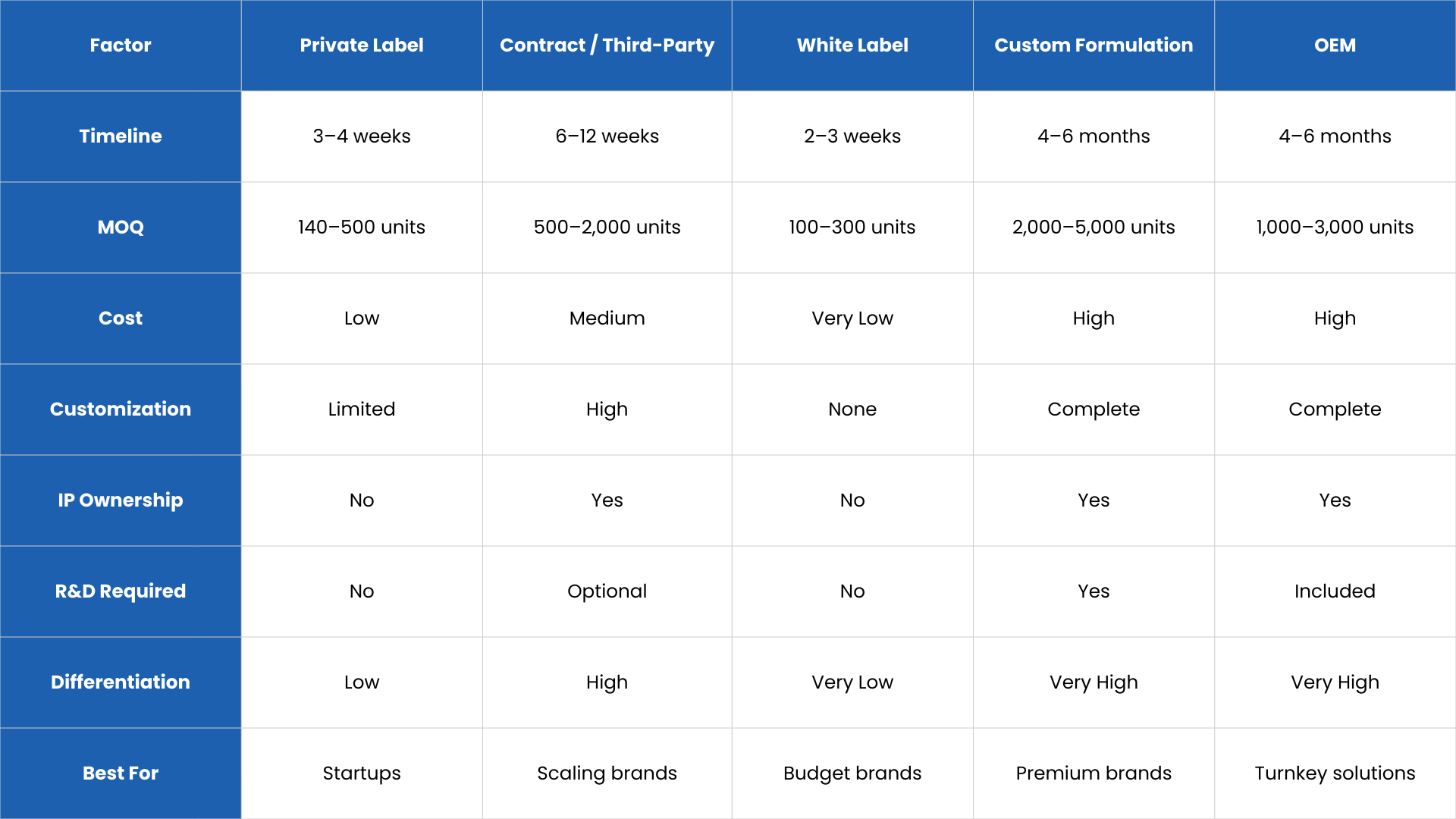
1. Private Label Manufacturers
What They Do:
The Top Private label cosmetic manufacturers in India produce cosmetics using their existing, pre-formulated products that you can brand and sell under your own company name.
How It Works:
- The manufacturer has ready-made formulations (creams, serums, shampoos, etc.)
- You select products from their catalog
- Add your branding, packaging, and labels
- Products are manufactured and delivered under your brand name
Example: A startup skincare brand can launch existing vitamin C serum formula, by adding their unique branding and packaging design with the help of a private label manufacturer.
2. Contract/Third-Party Manufacturers
What They Do:
Top cosmetic contract manufacturing companies allow brands to outsource their production to specialized facilities that create products precisely according to their required specifications and formulations.
How It Works:
- You provide the formula (or work with their R&D team)
- Manufacturer produces products to your exact specifications
- You maintain ownership of the formula and brand
- Manufacturer handles production, quality control, and packaging
Example: An established beauty brand with a unique anti-aging formula partners with a third-party cosmetic manufacturer to handle production while they focus on expanding distribution channels.
3. White Label Manufacturers
What They Do: White label manufacturers produce generic, unbranded products that multiple companies can purchase and rebrand as their own.
How It Works:
- Manufacturer creates generic formulations
- Multiple brands can purchase the same product
- Each brand adds their own packaging and branding
- Products are identical except for external branding
Key Difference from Private Label: While similar, white label typically refers to completely generic products, whereas private label often involves some customization options (scents, colors, packaging variations).
4. Custom Formulation Manufacturers
What They Do: These manufacturers develop unique, proprietary custom formulations specifically tailored to your brand’s requirements, target audience, and positioning.
How It Works:
- Collaborative R&D process with in-house chemists
- Formulation developed based on your specifications
- Multiple iterations and testing phases
- You own the intellectual property rights
- Exclusive formula for your brand
Example: A luxury skincare brand develops a custom formulation combining Indian ayurvedic ingredients with modern peptide technology, creating a unique product unavailable elsewhere.
5. OEM (Original Equipment Manufacturer)
What They Do: OEM cosmetic manufacturers provide complete end-to-end product development services, from concept to finished product, including formulation, packaging design, and regulatory compliance.
How It Works:
- You provide the concept and requirements
- Manufacturer handles entire product development
- Includes formulation, packaging sourcing, design, testing, and compliance
- Turnkey solution requiring minimal involvement from your side
- Complete product delivered ready for market
Example: An international beauty brand wanting to launch in India partners with an OEM manufacturer who handles everything, from developing India-specific formulations to navigating CDSCO regulations and sourcing locally-appropriate packaging.
Product Categories Manufactured by Indian Top Cosmetic Manufacturers
Indian cosmetic manufacturers offer comprehensive production capabilities across all major beauty and personal care categories.
1. Skincare Products
India’s skincare manufacturer segment is the fastest-growing category, driven by increasing awareness and demand for specialized treatments.
Popular Products:
- Face creams and moisturizers (day creams, night creams, anti-aging formulations)
- Serums and concentrates (vitamin C, hyaluronic acid, niacinamide, retinol)
- Sunscreens and SPF products (mineral, chemical, hybrid formulations)
- Cleansers and face washes (gel, foam, cream, oil-based)
- Toners and essences (hydrating, exfoliating, pH-balancing)
- Face masks and treatments (sheet masks, clay masks, peel-off masks)
- Eye creams and treatments (dark circles, puffiness, anti-aging)
- Exfoliators and scrubs (physical, chemical, enzyme-based)
- Anti-aging products (peptides, growth factors, stem cells)
- Acne treatments (salicylic acid, benzoyl peroxide, natural alternatives)
2. Haircare Products
Haircare product manufacturers in India leverage the country’s rich tradition of hair care with modern scientific formulations.
Popular Products:
- Shampoos (clarifying, moisturizing, anti-dandruff, color-safe, sulfate-free)
- Conditioners (rinse-out, leave-in, deep conditioning treatments)
- Hair oils (coconut, argan, bhringraj, amla, herbal blends)
- Hair serums (anti-frizz, shine-enhancing, heat protection)
- Hair masks and treatments (protein treatments, bond repair, keratin)
- Styling products (gels, mousses, sprays, pomades, waxes)
- Hair growth treatments (minoxidil-based, natural stimulants)
- Scalp treatments (anti-dandruff, soothing, exfoliating)
- Hair colors and dyes (permanent, semi-permanent, natural henna-based)
3. Color Cosmetics (Makeup)
Indian manufacturers are increasingly capable of producing high-quality color cosmetics meeting international standards.
Popular Products:
- Lipsticks (matte, satin, glossy, liquid, long-wear)
- Foundations and BB/CC creams (liquid, powder, stick, cushion)
- Concealers (liquid, cream, stick formulations)
- Eye products (eyeshadows, eyeliners, mascaras, brow products)
- Face powders (loose, pressed, setting, finishing)
- Blushes and bronzers (powder, cream, liquid)
- Highlighters and illuminators
- Primers (face, eye, lip)
- Makeup removers (oil-based, micellar water, balms)
4. Personal Care Products
Personal care manufacturing covers daily hygiene and wellness products which have now growing demand for natural alternatives.
Popular Products:
- Deodorants and antiperspirants (roll-on, spray, stick, natural)
- Body washes and shower gels (moisturizing, exfoliating, antibacterial)
- Hand sanitizers (gel, spray, foam formulations)
- Body lotions and creams (moisturizing, firming, whitening)
- Hand and foot creams (intensive care, anti-aging)
- Intimate hygiene products (washes, wipes, creams)
- Talcum and body powders
- Bath salts and bombs
5. Ayurvedic/Herbal Cosmetics
India’s unique strength lies in ayurvedic cosmetic manufacturing, combining ancient wisdom with modern science.
Popular Products:
- Herbal face packs and ubtan (turmeric, sandalwood, neem)
- Ayurvedic hair oils (bhringraj, amla, brahmi, hibiscus)
- Natural soaps (handmade, cold-processed, glycerin-based)
- Herbal creams and lotions (kumkumadi, saffron, aloe vera)
- Essential oil blends (aromatherapy, therapeutic)
- Herbal shampoos and cleansers (shikakai, reetha, amla)
- Natural scrubs (walnut, apricot, coffee, sugar)
- Ayurvedic supplements (skin and hair health)
6. Men’s Grooming Products
The men’s grooming segment is the fastest-growing category in Indian cosmetics, expanding at 18% CAGR.
Popular Products:
- Beard oils and balms (conditioning, growth-promoting, styling)
- Face washes (oil-control, brightening, anti-acne)
- Shaving products (creams, gels, foams, aftershave)
- Hair styling products (pomades, waxes, gels, clays)
- Men’s skincare (moisturizers, serums, anti-aging)
- Body washes (energizing, cooling, deodorizing)
- Deodorants (sport, fresh, woody fragrances)
- Hair removal creams
7. Baby Care Products
Baby care manufacturing requires specialized facilities and stringent safety standards.
Popular Products:
- Baby lotions and creams (moisturizing, diaper rash, massage oils)
- Baby shampoos (tear-free, gentle, hypoallergenic)
- Baby soaps and body washes (mild, fragrance-free)
- Baby powders (talc-free alternatives)
- Baby wipes (gentle, alcohol-free)
- Diaper rash creams (zinc oxide, natural alternatives)
- Baby sunscreens (mineral-based, gentle formulations)
How to Choose the Top Cosmetic Product Manufacturer in India
Choosing a top cosmetic product manufacturer in India is not just a procurement decision, it’s a strategic move that shapes your brand’s quality, credibility, and long-term growth. Below is a detailed guide written with expert insight into what each step really involves and where professional guidance makes a difference.
1. Define Your Requirements Clearly
Before reaching out to manufacturers, define exactly what you want to create. List your product type (e.g., skincare, haircare, ayurvedic), desired formulation, packaging concept, and target market (mass, premium, or luxury).
Also decide:
- What’s your initial quantity or Minimum Order Quantity (MOQ)?
- What’s your realistic budget range?
- Will your product need special certifications (organic, vegan, cruelty-free)?
2. Research and Shortlist Manufacturers
Start by searching for verified private label cosmetic manufacturer India listings through government trade portals (like MSME, IndiaMART, or ExportHub) and attending industry expos such as CosmoTech Expo or In-Cosmetics Global India.
Compare manufacturers based on:
- Product specialization (skincare, ayurvedic, or color cosmetics)
- Reputation and client portfolio
- Export experience and scalability
3. Verify Credentials and Compliance
Every reliable cosmetic product manufacturer in India should meet specific regulatory and quality standards.
Check for:
- GMP (Good Manufacturing Practices) certification
- ISO 22716:2007 (Cosmetics Good Manufacturing Practices)
- Ayush, CDSCO, or FDA approvals (depending on category)
- Factory license and safety audits
4. Request Quotes and Compare Objectively
Once you’ve shortlisted candidates, ask for detailed quotations. Evaluate not just the cost per unit, but the total value, including R&D support, packaging assistance, and after-sales service.
Compare:
- Formulation flexibility (custom vs standard)
- Minimum Order Quantities (MOQ)
- Estimated delivery timelines
- Payment terms
5. Ask for Samples and Test Reports
Before committing to production, request samples of your shortlisted formulations. Evaluate them for texture, scent, absorption rate, and performance. Ask the manufacturer for stability and dermatological test reports if available.
6. Schedule a Facility Visit or Virtual Tour
If possible, visit the manufacturing plant or request a live video tour. Observe hygiene practices, automation levels, packaging lines, and storage conditions.
7. Check Client Testimonials and References
Authentic feedback reveals much more than brochures. Ask for contact details of existing or past clients, especially brands in your niche.
Look for:
- Product consistency feedback
- Communication transparency
- Post-delivery support
8. Review Contract Terms Thoroughly
Before signing, carefully read all terms covering:
- Intellectual Property (IP) protection for your formula and packaging design
- Payment milestones and refund conditions
- Delivery commitments and late penalties
- Confidentiality clauses
9. Start with a Pilot Batch
Don’t rush into bulk production. Begin with a pilot batch of limited units to test the product’s performance, packaging durability, and market acceptance. Use this phase to fine-tune scent, texture, and labeling before committing to mass production.
10. Build a Long-Term Partnership
The most successful brands don’t switch manufacturers frequently, they build long-term partnerships based on mutual trust and innovation.Maintain open communication about new trends, packaging innovations, or regulatory updates.
Final Word
Working with the top cosmetic product manufacturer in India isn’t just a supply chain decision; it’s a collaborative relationship that defines your brand’s integrity. With expert guidance in documentation, brand storytelling, and compliance, you can turn manufacturing into a competitive advantage rather than a challenge.