If you’re building a beauty, skincare, or personal care brand, one of the first major decisions you’ll face is choosing how your products are made. Two popular manufacturing models, private label and contract manufacturing, both help brands bring products to market without owning their own production facility. But they’re not the same.
Understanding the difference between private label and contract manufacturing can impact your product quality, branding flexibility, cost structure, timeline, and long-term growth.
In this guide, we break down both models, explain their advantages and limitations, and help you decide which is the best fit for your business.
1. What Is Private Label Manufacturing?
Private label manufacturing is when a company produces pre-formulated products that multiple brands can purchase and sell under their own brand name. These products are already developed, tested, and often ready to package.
Key Characteristics
- Uses standard, pre-existing formulas
- Limited customization (mostly packaging and branding)
- Lower cost of entry
- Faster turnaround time
Example
Private Label Cosmetic Manufacturers produce a moisturizing lotion that many brands can buy, label, and sell as “Brand A Moisturizing Lotion” or “Brand B Hydrating Cream.”
Who It’s Best For
- New brands testing product ideas
- Businesses with limited R&D budget
- E-commerce and retail products with broad appeal
2. What Is Contract Manufacturing?
Contract manufacturing (also known as custom manufacturing) involves partnering with a manufacturer to produce products according to your custom formulation, fragrance, texture, and ingredient requirements. You essentially “contract out” the production rather than buying an off-the-shelf product.
Key Characteristics
- Fully customized product formulas
- Greater control over ingredients and features
- Higher investment in time and cost
- Stronger brand differentiation
Example
You develop a unique anti-aging serum with specific actives and performance claims. The Cosmetic Contract Manufacturer blends, tests, and produces it according to your specifications.
Who It’s Best For
- Brands seeking unique formulations
- Businesses focused on niche or premium positioning
- Companies with strong branding and R&D vision
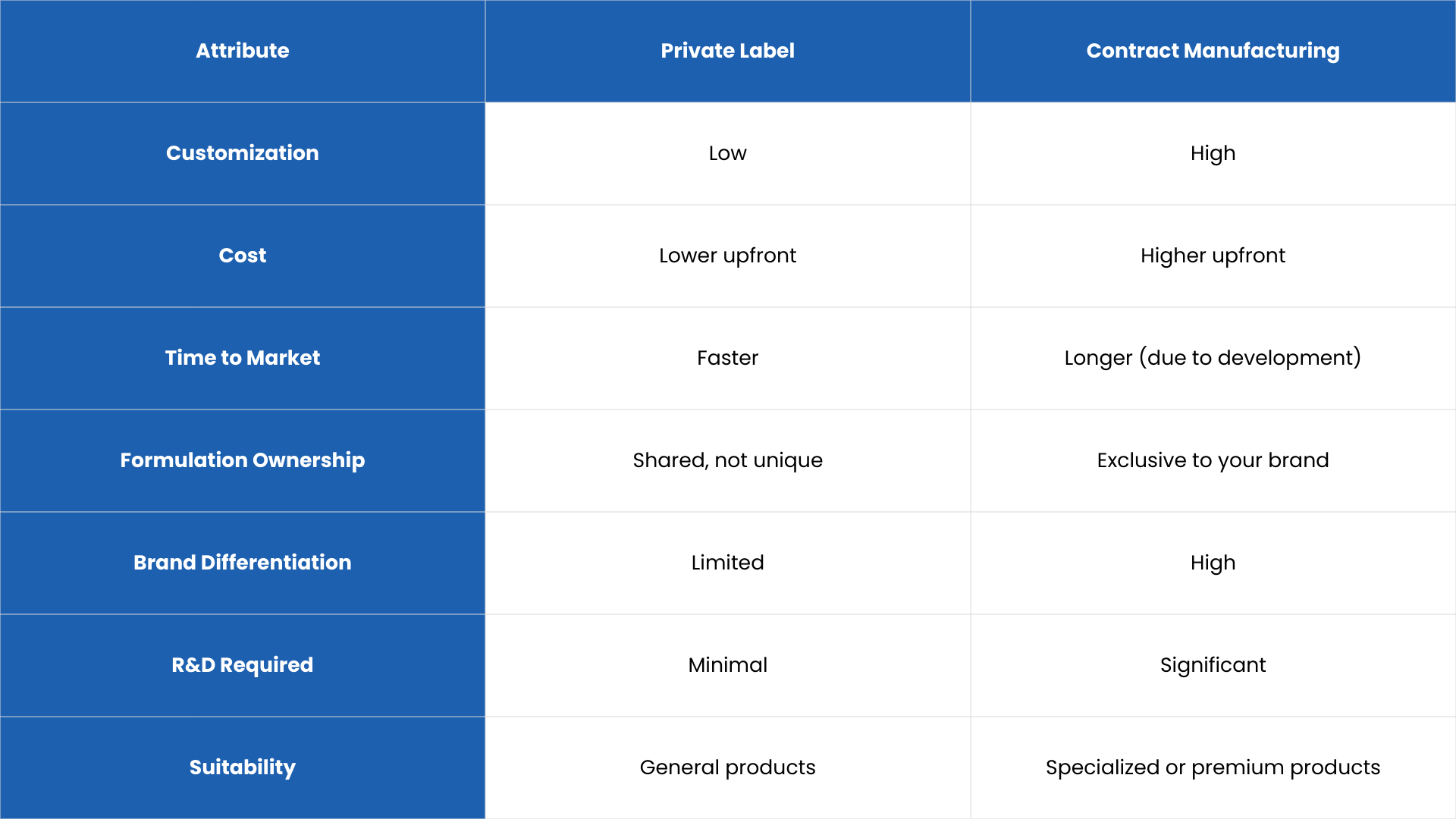
3. Private Label vs. Contract Manufacturing — Key Differences
4. Pros and Cons
4.1 Private Label Manufacturing
Pros
- Quick Launch: Products are already developed and tested.
- Low Cost: Minimal R&D and formulation expenses.
- Simplified Process: Manufacturer handles production; you handle branding and sales.
Cons
- Lack of Uniqueness: Other brands may sell the same formula.
- Limited Customization: Only packaging and brand identity can be modified.
- Less Control: You cannot change ingredients or performance characteristics.
4.2 Contract Manufacturing
Pros
- Unique Products: You create formulations that reflect your brand’s mission.
- Higher Brand Value: Unique products can command premium pricing.
- Ingredient Control: You choose what goes in, and what stays out.
Cons
- Higher Cost: R&D, testing, and custom formulation add to expenses.
- Longer Development Time: Creating and testing custom formulas takes time.
- More Complex: Requires deeper collaboration and planning with the manufacturer.
5. Cost Comparison
The cost structure between private label and contract manufacturing varies significantly:
Private Label
- Lower Development Costs: No custom R&D
- Standard MOQ (Minimum Order Quantity): Often small
- Affordable Packaging Options: Less specialized
Contract Manufacturing
- Higher Development Costs: Includes formulation, stability testing, and trial batches
- Potentially Higher MOQ: To justify R&D investment
- Custom Packaging Programs: Premium design and bespoke options
Expert Tip: If you’re budget-constrained but want unique branding, start with a private label and transition to contract manufacturing as demand grows.
6. Quality and Safety Standards
Regardless of the model you choose, quality and safety must never be compromised.
Important Certifications to Look For
- GMP (Good Manufacturing Practices)
- ISO quality standards (e.g., ISO 22716)
- Country-specific approvals (FDA, CDSCO, EU regulations)
- Cruelty-free, vegan, organic badges if relevant to your brand positioning
7. Branding and Packaging Flexibility
Private Label
- Packaging is usually customizable only at the surface level (label design and graphics)
- Structure and formula are fixed
Contract Manufacturing
Full control over:
- Formula
- Packaging type and materials
- Label claims and messaging
- Regulatory compliance labeling
Branding advantage: With custom formulas, your product becomes distinct, not just another lotion with a new label.
8. Timelines: From Concept to Shelf
Private Label
- Weeks to Launch: Often 4–8 weeks
- Production is ready once packaging is finalized and order confirmed
Contract Manufacturing
- Months to Launch: 8–24+ weeks
Timeline includes:
- Concept development
- Formulation and prototyping
- Stability and safety testing
- Packaging design & compliance
- Mass production
9. Which Model Is Right for Your Brand?
Here’s how to decide:
Choose Private Label If:
- You need to launch fast
- You’re testing a new product idea
- Your focus is on branding and marketing
- You have a limited budget
Choose Contract Manufacturing If:
- You want unique products
- Your brand has a clear voice and positioning
- You plan to scale long-term
- You target mid-to-premium or specialized markets
10. Case Examples (Hypothetical)
Brand A: Quick Start with Private Label
A small e-commerce skincare brand wants to launch a moisturizer and cleanser within 60 days. They select a private label partner with ready products, customize packaging, and begin selling online within two months.
Outcome: Fast launch, modest budget, limited uniqueness
Brand B: Custom Line with Contract Manufacturer
A new natural wellness brand wants a caffeine-infused anti-aging serum with specific ingredients and performance claims. They partner with a contract manufacturer to develop, test, and launch a proprietary product.
Outcome: Distinct product with brand-owned formulation, stronger market differentiation
11. Tips for Working with Manufacturers
Regardless of the model:
- Request samples before placing bulk orders
- Verify certifications and compliance standards
- Check client testimonials and references
- Start with a pilot batch to test demand
- Protect your intellectual property in contracts
Conclusion
Choosing between private label vs. contract manufacturing is a strategic decision based on your budget, speed, customization needs, and long-term brand goals.
- Private label offers simplicity, speed, and lower costs
- Contract manufacturing offers uniqueness, control, and scalability
Both have valuable roles in modern beauty and personal care brands, the right choice depends on where your brand is today and where you want it to go tomorrow.
Frequently Asked Questions
Q1. Is private label cheaper than contract manufacturing?
Generally, yes, private label manufacturers avoid custom R&D costs, making it more affordable initially.
Q2. Can private label products be customized?
To a limited degree, usually packaging and label design only. Formula and features remain fixed.
Q3. Do I own the formulation with contract manufacturing?
Often, yes, especially if you pay for development. But always clarify ownership in contracts.
Q4. Which model sells better?
Neither model guarantees sales, success depends on product quality, branding, marketing, and market fit.